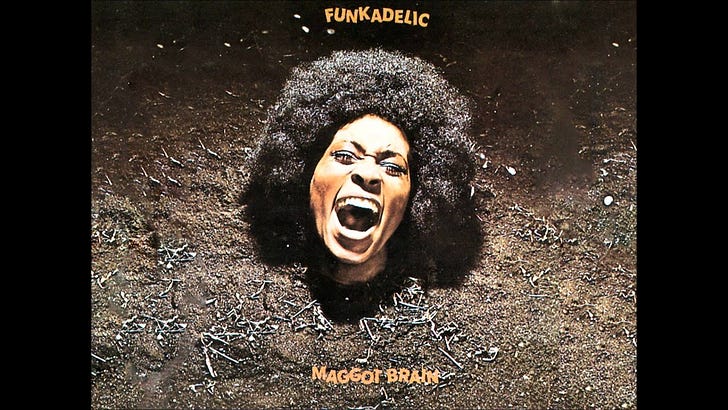
Exegesis: Funkadelic's "Maggot Brain"
George Clinton's masterpiece of semi-Satanic psychedelic Afro-futurism
In Exegesis posts, I project my own ideas onto popular art—mainly fiction, music, and film—with little regard for the artist’s intentions. Past subjects include Tarkovsky’s Stalker. Future subjects will include Octavia Butler’s Earthseed Series, the music of Dan Deacon, and TV’s Adventure Time.
Exegesis posts are a thank you for paid subscribers. All other Superb Owl content is free thanks to your support.
Mother Earth is pregnant for the third time
For y'all have knocked her up.
I have tasted the maggots in the mind of the universe
I was not offended
For I knew I had to rise above it all
Or drown in my own shit.—Opening lines of Maggot Brain
Funkadelic’s Maggot Brain is one of those rare albums that expanded the boundaries of the word “music”. Its loose, genre-bending style has influenced groups as wide-ranging as Outkast, Audioslave, and Ween. Despite an initially lukewarm reception, it’s become a regular on “best albums of all-time” lists.
Thematically, the album is an unflinching examination of death, darkness, violence, and fear. There are spiritual and political overtones, underlined by the inclusion of a long rant from a controversial cult in the liner notes (reproduced in part below).
Led by the legendary George Clinton, Funkadelic—an all-Black, psychedelic-fueled band living in 1970s America—saw life through an understandably dark lens. While White folks on acid were churning out frivolities like Sugar Magnolia and Strawberry Fields Forever, Funkadelic stared straight into the abyss.
Outline
Your Mother’s Death
Fear Itself
Rebellion
Afro-Future
Your Mother’s Death
In these seven songs, you can hear Funkadelic attempting to make sense of the turmoil of the times, as they express the euphoria and anguish of being born and dying in the most extraordinary ways.
—Dave Segal, in his review for Pitchfork
Maggot Brain opens with what is arguably one of the greatest guitar solos of all time—recorded in one take by an LSD-fueled Eddie Hazel, with a genius prompt from George Clinton:
Eddie and I were in the studio, tripping like crazy but also trying to focus our emotions. I told him to play like his mother had died, to picture that day, what he would feel, how he would make sense of his life, how he would take a measure of everything that was inside him.
I knew immediately that he understood what I meant. I could see the guitar notes stretching out like a silver web. When he played the solo back, I knew that it was good beyond good, not only a virtuoso display of musicianship but also an almost unprecedented moment of emotion in pop music.
Clinton’s decision to open the album with a ten minute instrumental was strange—not exactly a recipe for commercial success. But the track sets up the album perfectly. As the solo lulls and then begins to crescendo around the seven minute mark, I get the sense that I’m witnessing the rebirth of a universe.
The second (and most famous) track brings the tone back up to the lively funk-rock that Clinton is known for. While it’s ostensibly about a failed relationship, the song alludes to MLK’s I Have a Dream speech, setting up the connection between the album’s dark tone and the treatment of Black folks in America.
America has given the negro people a bad check, a check which has come back marked insufficient funds.
—Martin Luther King Jr., I Have a Dream
When you base your love on credit and your loving days are done
Checks you signed with a-love and kisses later come back signed "Insufficient funds"—Funkadelic, Can You Get to That
The album continues to shake off its melancholy start with the jam Hit It and Quit It, but hits it stride with You and Your Folks, Me and My Folks, a protest against wealth inequality:
You want peace
I want peace
They want peace
And the kids need peace
There won't be no peace
The rich got a big piece of this and that
The poor got a big piece of roaches and rats
But unlike most politically-oriented music, the song doesn’t really single out “the rich” as an enemy. Maggot Brain’s lyrics repeatedly point to the seeds of darkness in each individual soul—specifically naming those seeds as “fear”:
If in our fears, we don't learn to trust each other
And if in our tears, we don't learn to share with your brother
You know that hate is gonna keep on multiplying
And you know that man is gonna keep right on dying—You and Your Folks, Me and My Folks
Super stupid bought a nickel bag
Thought it was coke, but it was skag [heroin]
Super stupid did a one and one
Then his eyes begin to water and his nose begin to runOh! stupid with your ups and downs
Your maggot brain, your grins and frowns
Super stupid you're here today
You've lost the fight and the winner is fear—Super Stupid
Fear Itself
If Maggot Brain has a central theme, it’s fear. In the Maggot Brain universe, fear is the root of evil, and our unwillingness to confront that fear allows it to expand to catastrophic dimensions.
The album’s philosophy is spelled out explicitly in the liner notes:
Fear is at the root of man’s destruction of himself. Without Fear there is no blame. Without blame there is no conflict. Without blame there is no destruction. But there IS Fear; deep within the core of every human being it lurks like a monster; dark and intangible. Its outward effects are unmistakable. Its source is hidden.
…The tight-lipped suppression of the rigid moralist reflects it, as does the violent protest of the anarchist. But more starkly and tragically than anywhere else, it manifests in pale grey shadow of the ordinary person, whose fear clamps down on all his instincts and traps him in the narrow confines of the socially accepted norm. Afraid either to step down into the darkness of his lower self or to rise up into the light of his higher self, he hangs suspended in between, stultified into an alien pattern of nothingness.
But to a greater or lesser degree, and manifesting one way or another, all human beings are afraid. And some of us are so afraid that we dare not show our fear. Sometimes we dare not even know our fear. For Fear itself is a terrifying concept to behold.
…And do we know that one thing only ensures the escalation of the spiral of violence and destruction; our unwillingness to recognise the full extent of our fear and its effects—our fear of fear?
For each and every one of us, as long as he is afraid…will fail to see their part in the relentless tide of hatred and violence, destruction and devastation, that sweeps the earth. And the tide will not ebb until all is destroyed.
The polemic (full text here) is lifted from a manifesto published by a semi-Satanic cult: The Process Church of the Final Judgement. The inclusion proved even more controversial than expected; in 1971, the same year Maggot Brain was released, The Process Church gained infamy after being connected (probably erroneously) to the Manson Family murders of 1969.1
The band struggled to justify their relationship with the cult, but didn’t back down. The Process Church reprised their role in the liner notes on Funkadelic’s 1972 album America Eats Its Young; the album also includes a track titled Miss Lucifer’s Love.
Which raises the question: why would Funkadelic (or anyone, for that matter) deliberately associate themselves with Satanism?
Rebellion
Satan and his angels rebelled against God in heaven, and proudly presumed to try their strength with his. And when God, by his almighty power, overcame the strength of Satan, and sent him like lightning from heaven to hell with all his army; Satan still hoped to get the victory by subtlety
—Jonathan Edwards, Wisdom Displayed in Salvation
In Christian societies, Satanic imagery often infuses and supports the counterculture. It’s a tremendous antimeme, subverting the foundational beliefs and values of the host society. Moral inversion provides an immediate escape hatch from the mainstream.
(I do want to point out that, like any powerful tool, moral inversion is extremely dangerous; some non-trivial percentage of the time it leads to psychosis and violence. Christianity has developed some weird, unnecessary, even harmful rules, but “don’t kill people” is a pretty good one. Consider dabbling in Paganism instead.)
Rock and roll, too, has been a symbol of social rebellion since at least the 1960s. And the link between rock and Satanism has been rooted in popular imagination since it’s origins: “first ever rock star” Robert Johnson was rumored to have sold his soul to the Devil at a crossroads.
Satanism’s antimemetic power goes far beyond inspiring disaffected teens to blast AC/DC and perform graveyard rituals—it’s played an important (albeit underground) role in legitimate rights movements. Satanic imagery has been leveraged by feminists and LGBT activists; most recently, rapper Lil Nas X scandalized the world by embracing Satanic imagery in connection with his homosexuality.
What’s odd to me is that Satanism hasn’t played a more powerful role in Black counterculture. Black Americans have mostly embraced Christianity’s message of salvation for the poor, rather than rejecting it as a religion pressed upon them in captivity. Civil Rights Movement icons were mainly Christian preachers like MLK and Jesse Jackson; even hardcore rebels like Malcom X only took the more oblique step to Islam. All this despite the fact that American Christianity often uses color-based imagery, associating white with good and darkness with evil, even going so far as to depict Jesus and God as White men and the Devil as a Black man.
George Clinton seems to be one of the few Black artists to fully embrace anti-Christian themes as a way of subverting these narratives. But he’s clear that he’s not fully endorsing or promoting Satanism, the way Lil Nas X might be. He’s simply trying to disrupt the listener’s mind, to dislodge them from oppressive patterns of thought.
I try to make it funny. I know what’s goin on, I ain’t tryin to be no role model. Don’t follow me. I don’t want to lead nobody down no road that I ain’t ready to go down myself…I don’t know no answers, I just know that learning how to learn is really important…My whole thing is to say something that makes you [ask] “what is he talking about? why is he talking about that?” I just throw it out there. It might be true now for the next ten years, but after ten years, society might change, and that might be the worst thing they could [be] into…
I know it’s a movement, but it’s a movement to dance your way out of your constriction…learn how to learn.—George Clinton, Interview with Killer Mike [emphasis mine]
Aside from Robert Johnson, the only2 other Black musician I associate with Satanic imagery is Miles Davis, who created works with titles like Live-Evil, Dark Magus, and Black Devil. The connection isn’t superficial—Davis was so inspired by the percussion on Maggot Brain’s last track that he poached drummer Tiki Fulwood from the band.
Afro-Future
The opener “Maggot Brain” and closer “Wars of Armageddon” are the most evocative expressions of birth and annihilation ever put on record.
—Dave Segal, in his review for Pitchfork
The final two tracks of Maggot Brain mirror the album’s entire arc, contrasting birth and death, light and dark, love and fear.
First, Back in Our Minds takes things to a more hopeful place:
We don't fight no more
We done closed that door
This time for sure
We can't stand no more
Fussin' and a-cussin' each other
When we're supposed to be brothers
Livin' in this world we all live in
But then the album closes with one of the weirdest avant-garde jazz-fusion songs I’ve heard (and I’ve heard a lot of weird shit). Wars of Armageddon features sirens, screams, babies crying, a cuckoo clock, a cow mooing, and a litany of fart sounds—all against a steady, driving beat. Towards the end, two voices in dialogue deconstruct protest chants, creating a sense of both perceptual and ideological disorientation.
More power to the people
More pussy to the power
More pussy to the people
More power to the pussy
More pussy to the power
Power to the pussy!
More peter to the eater
More power to the pussy
More pussy to the power
Right on, right on!
In the end, Maggot Brain is an antimemetic triumph. It contains songs both catchy and confounding, light-hearted and deadly serious. It’s a dizzying display of musicianship and psychological savvy.
Maggot Brain was going places that Black groups hadn’t gone, into questions about whether America was still on the right path or whether the promise of the late ’60s had completely evaporated.
—George Clinton, Brothas Be, Yo Like George, Ain't That Funkin' Kinda Hard On You?: A Memoir
Most importantly, Maggot Brain challenges the values and beliefs that gave rise to a radically oppressive society. It doesn’t attack specific people, classes, or institutions; it cuts right to the heart of every listener, challenging us to confront our own demons.
Interestingly enough, The Process Church has mutated into an animal welfare organization.
I did find two other notable examples:
Three 6 Mafia’s name and lyrics reference the Devil
Screamin’ Jay Hawkins embraced occult and savage imagery in his performances, differentiating himself from more White-friendly musicians like Chuck Berry
If you know of other Black musicians who used Satanism to subvert Christian narratives, drop them in the comments.


Listened to the album for the first time due to your post. Amazing!
> The final two tracks of Maggot Brain mirror the album’s entire arc, contrasting birth and death, light and dark, love and fear.
This reminds me of Can's Tago Mago, which it sounds like you probably have heard? It's a real trip on acid. I never really got the second, dark, half until I listened to it on acid, and now I enjoy it. I really like the final track, which is like finally landing, drinking tea with trembling hands.