Exegesis: Stalker and Roadside Picnic
Dissecting Tarkovsky's masterpiece and the novel it was based on
In Exegesis posts, I project my own ideas onto popular art—mainly fiction, music, and film—with little regard for the artist’s intentions. Future subjects will include Octavia Butler’s Earthseed Series, the music of Dan Deacon, and TV’s Adventure Time.
Exegesis posts are a thank you for paid subscribers. All other Superb Owl content is free thanks to your support.
Andrei Tarkovsky—easily one of the best directors of all-time—is known for creating visually stunning films that delve into psychology, spirituality, and metaphysics. Fortunately for my purposes, his work is also wildly vague and self-contradictory. Much like the Bible, you can find evidence for nearly any assertion.
Stalker is no exception. Here’s the premise: our hero—the eponymous Stalker—leads a writer and a professor into The Zone, a heavily-guarded area full of mystery and danger. The film follows their quest for The Room—a spot in The Zone where your innermost desires are made real.
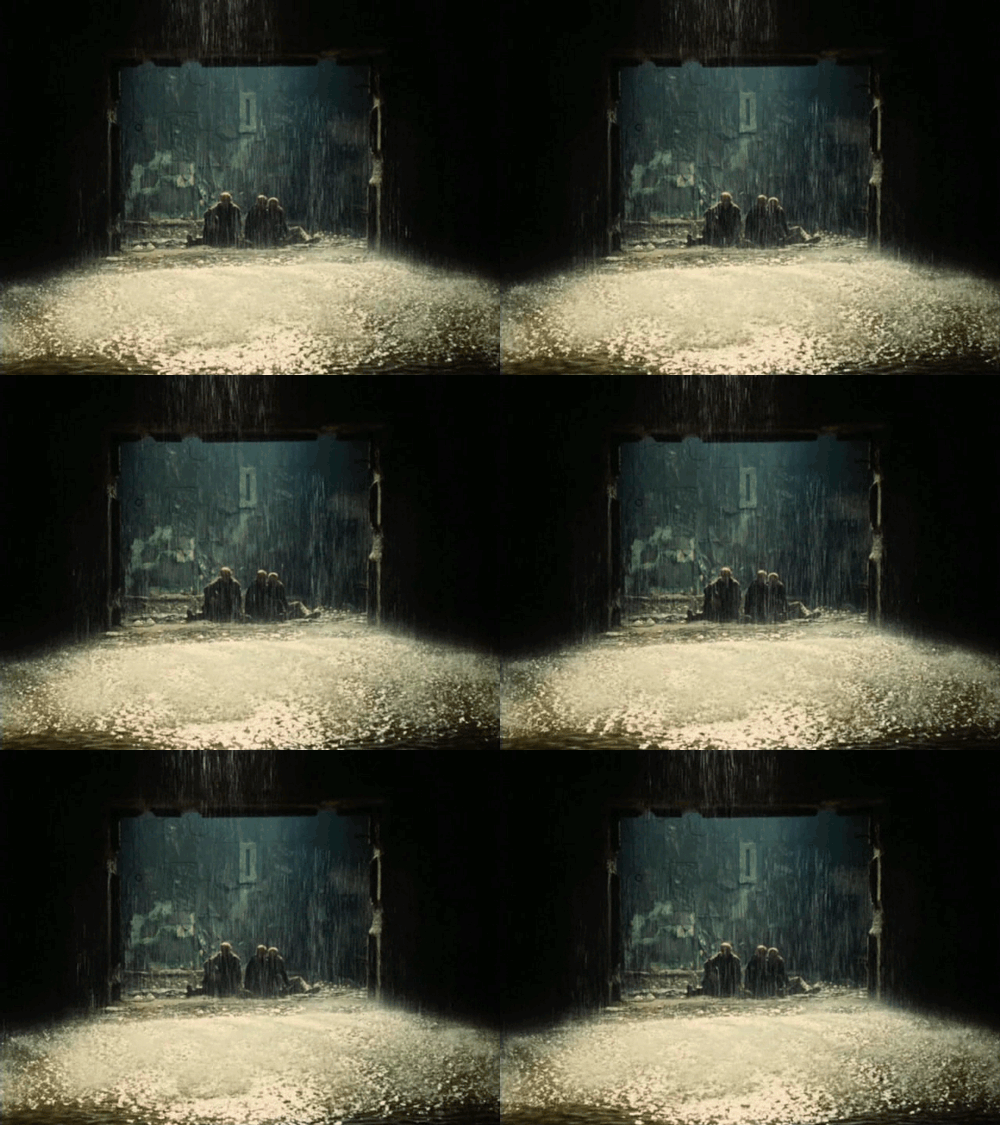
The story is loosely based on the Strugatsky brothers’ Soviet-era novel Roadside Picnic, which offers a little more detail. We’re told that The Zone is the site of an alien landing, but that the visitors rudely left without saying hello. Humans scavenge the area for world-changing technologies like ants picking through the detritus of a roadside picnic—and frequently get themselves caught in the extraterrestrial equivalent of motor oil.
Aside from the main premise, the plots of the book and the film are wildly different.
…the script of Stalker has nothing in common with the novel…except for the two words, “Stalker” and “Zone”.
—Andrei Tarkovsky
But I have a deep love for both, and they ultimately deal with the same themes: fascination with the unknown, the dangers of terra incognita, and the tyranny of unconscious desire.
Outline
The Journey
The Territory
The Shaman
The Danger
The Unconscious
The Redemption
The Journey
I like to view both Roadside Picnic and Stalker as allegories for mysticism—especially the strange, syncretic, psychedelic-fueled mysticism that surged in the 1970s (Roadside was published in 1972; Stalker debuted in 1979).
Meditation is typically thought of as a wholesome, feel-good practice; increasingly, psychedelics are seen in a similar light. But any hardened psychonaut will tell you: there are dragons here. These practices thrust the would-be mystic into a mental space that is massive and perilous; many lose their minds.
Compare to The Zone: an area of extreme risk and reward, which exerts a magnetic pull on our hero and other adventurers.
Stalker: The Zone wants to be respected. Otherwise it will punish.
Traditions like Catholic monasticism or Zen Buddhism have firmly established boundaries which allow for safe exploration (e.g. separating mystics from the rest of society, and telling them to keep their mouths shut take a vow of silence). The decentralized New Age movement—which probably started with Theosophy and reached its apex in the 70s—is much more cavalier, and has the casualties to prove it.
Despite the dangers, many of us—myself included—still choose to walk that path. We do it because we understand that if we’re cautious and respectful, there can be immense benefits. (I have not always been cautious and respectful.)
For those willing to forge a path through dangerous and unknown territory, both The Zone and contemplative practice offer lasting fulfillment.
The Territory
For all its alleged danger, The Zone in Stalker is portrayed as a place of rich beauty, especially in contrast to the outside world.
Scenes outside The Zone are shot with a rusty sepia tone. The movie begins in the hero’s sparse, dilapidated apartment:
But the moment we enter The Zone, Stalker announces “We are home!”, and the palette becomes rich with blues and greens. The camera is filled with thriving flora and rushing water. Stalker takes a few minutes to wander off and have a weirdly sensual roll-around in some bushes.
In the book, The Zone is consistently desolate and dangerous, but it’s full of useful technologies—perpetual motion machines, weaponry, etc—all of which can be sold to local loot dealers.
So we have two aspects of contemplative practice represented here: from the movie, the deep sense of well-being long-time meditators are able to access (often described as “returning home”); from the book, the spiritual technologies uncovered by psychonauts (e.g. bliss states, metta, equanimity, and a self-modulation that can help with depression and addiction).
And both the book and the movie contain a tantalizing MacGuffin: a holy grail that makes dreams come true. In my allegory, this is the ultimate “enlightenment” or “divine union” sought by contemplatives.
But if we want to find it safely, we’ll need a guide.
The Shaman
Stalker serves the role of shaman, guru, or psychopomp. He has been through The Zone over and over, guiding initiates to The Room.
Writer: Listen…You've brought so many people here.
Stalker: Not as many as I would like.
Writer: It doesn't matter. Why did they come? What were they after?
Stalker: Happiness, more than anything.
Stalker is uniquely capable of navigating The Zone, and sees things others don’t. The book even has Stalker enter into a mystical state:
He had never felt this outside of the Zone, and even in the Zone it had only happened two or three times. Suddenly, he seemed to be in another world. A million smells assaulted him at once—smells that were sharp, sweet, metallic; dangerous, caressing, disturbing; as immense as houses, as tiny as dust particles, as rough as cobblestones, and as delicate and intricate as watch gears. The air turned hard, it appeared to have surfaces, corners, edges, as if space had been filled with huge coarse spheres, polished pyramids, and gigantic prickly crystals, and he was forced to make his way through all this, as if in a dream, pushing through a dark antique shop full of misshapen furniture…This only lasted a moment. He opened his eyes, and everything disappeared. This wasn’t another world—it was his same old world turning an unfamiliar side toward him, revealing it for an instant, then immediately sealing it off, before he even had the chance to investigate.
Stalker’s strategy often resembles the wu wei, action-through-nonaction typical of right-handed mystical practices. In the movie, he even quotes the Tao Te Ching:
Stalker: For softness is great and strength is worthless. When a man is born, he is soft and pliable. When he dies, he is strong and hard. When a tree grows, it is soft and pliable. But when it's dry and hard, it dies. Hardness and strength are death's companions. Flexibility and softness are the embodiment of life. That which has become hard shall not triumph.
Through his experience, Stalker has developed an intuitive feeling for The Zone; he knows how to proceed safely, and when to stop. But the path isn’t fixed—he navigates with a combination of superstition, guesswork, and luck. He’s confident, but always on the edge of terror.
Out of the three protagonists, he alone understands the magnitude of the mystery confronting them.
The Danger
When Writer complains that they’re taking a circuitous route rather than marching up to the front door, Stalker explains:
Stalker: Here, the straight path isn’t shortest. The more indirect, the less risk there is.
This is great advice for both Stalkers and mystics. When exploring the mysterium tremendum, the safest strategy is to move slowly, to look at things from all sides before proceeding further.
But Writer doesn’t listen. After only a short while meandering safely around The Zone, he breaks from the group to take a direct path, like a precocious teenager taking a breakthrough dose of DMT. The venture doesn’t end well; a disembodied entity commands him to stop, and he returns spooked, tail between his legs.
Stalker: The Zone is a very complicated system of traps, and they're all deadly. I don't know what's going on here in the absence of people, but the moment someone shows up, everything comes into motion. Old traps disappear and new ones emerge. Safe spots become impassable. Now your path is easy, now it's hopelessly involved. That's the Zone. It may even seem capricious. But it is what we've made it with our condition. It happened that people had to stop halfway and go back. Some of them even died on the very threshold of the room. But everything that's going on here depends not on the Zone, but on us! [emphasis mine]
Much like inner work, The Zone lays bare your innermost wants and fears.
The Unconscious
Writer: My conscience wants vegetarianism to win over the world. And my subconscious is yearning for a piece of juicy meat. But what do I want?
A common thread in both the book and the movie is that The Zone has a sort of apersonal life to it; it changes and moves. Most importantly, it responds to the minds of its inhabitants—especially Stalker’s Room and Roadside’s golden sphere, the holy grails rumored to grant wishes.
The characters in Stalker worry about the immense power The Room holds; the professor secretly plans to destroy it with a homemade bomb.
Professor: Imagine what will happen when everyone believes in this Room and when they all come hurrying here. It's only a question of time. Not today, but tomorrow. And in the thousands. All these would-be emperors, grand inquisitors, führers of all shades. The so-called saviors of mankind! And not for money or inspiration, but to remake the world.
Spiritual attainment comes with similar dangers. Any charismatic figure who claims enlightenment—credibly or not—can quickly amass a following. Even the well-intentioned, even those who have truly experienced enlightened states of consciousness, can become narcissistically inflated. The line between bodhisattva and cult leader is a blurry one. How can we be certain that we seek enlightenment “for the benefit of all sentient beings”, and not for our own selfish purposes?
Towards the end of the movie, we learn that one of Stalker’s colleagues entered The Room hoping to resurrect his brother; instead he’s granted immense wealth. He’s so ashamed to learn of his true desires that he commits suicide a week later.
The Redemption
Both Stalker and Roadside, despite being steeped in bleakness, end on a hopeful note.
Stalker’s wife, addressing the camera, explains that for all the hardship and danger, they are happy.
Stalker’s Wife: You've probably already guessed, that he's one of God's fools. Everyone around here used to laugh at him…Only what could I do? I was sure I'd be happy with him. I knew there'd be a lot of sorrow, but I'd rather know bitter-sweet happiness, than a grey, uneventful life. Perhaps I invented all this later. But when he came up to me and said: "come with me", I went. And I've never regretted it. Never. There was a lot of grief, and fear, and pain, but I've never regretted it, nor envied anyone. It's just fate. It's life, it's us. And if there were no sorrow in our lives, it wouldn't be better, it would be worse. Because then there'd be no happiness, either. And there'd be no hope.
There’s an implication that Stalker will soon take her and their daughter to live in The Zone, away from the depressing sepia-toned reality they inhabit.
Roadside Picnic ends quite differently, with Stalker and an unlucky compatriot finally stumbling upon the golden sphere. Stalker sends his unwitting partner to his death—a necessary sacrifice to reach the orb. But in an act of redemption, he echoes his partner’s dying words while addressing the orb in the book’s final lines:
…if you really are—all powerful, all knowing, all understanding—figure it out! Look into my soul, I know—everything you need is in there. It has to be. Because I've never sold my soul to anyone! It's mine, it's human! Figure out yourself what I want—because I know it can't be bad! The hell with it all, I just can't think of a thing other than those words of his—HAPPINESS, FREE, FOR EVERYONE, AND LET NO ONE BE FORGOTTEN!


